Website or landing page: which should you choose?
A practical comparison between a website and a landing page: when you need a focused page, when a complete site makes sense, and how to combine them.
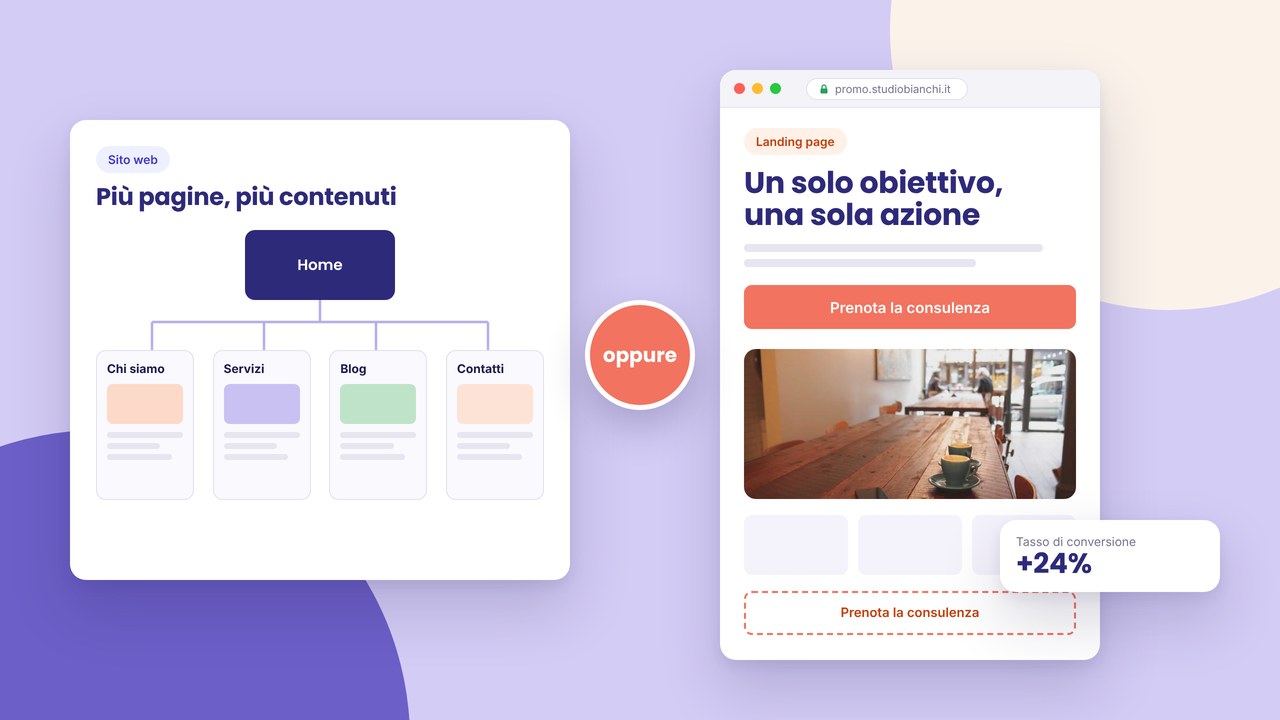
Website or landing page? It is one of the most frequent choices when a business wants to improve its online presence, launch a campaign or understand where to invest the budget. The answer does not depend on what “is in fashion”, but on the goal, the audience, the content available and the time you want to dedicate to organic growth.
In short: a landing page concentrates everything on one conversion; a website builds trust, SEO and structure over time. They are different tools, and they often work together. If you choose the wrong one, you risk having a page that is too thin to rank or a site that is too complex for a campaign that needed to be fast.
A simple difference: a single goal vs a complete presence
A landing page is a page designed for one action: a quote request, a sign-up, a download, a booking, the purchase of a package. It removes distractions and guides the user towards a precise step.
A website is a structure made of several pages: home, services, about, portfolio, blog, contact, FAQ. It is there to tell who you are, rank for more searches, answer different doubts and build trust over time.
When to choose a landing page
A landing is ideal when you have a specific offer and you want to measure the audience’s response quickly. Some typical cases:
- a Google Ads or Meta Ads campaign on a precise service;
- an event, workshop, webinar or temporary promotion;
- the download of a guide or lead magnet;
- the launch of a new product or package;
- a market test before building a larger site.
Here the advantage is speed: fewer sections, targeted copy, a clear CTA, simpler tracking. But the landing must be designed well. A short but confusing page converts worse than a complete site. To go deeper on structure and a checklist: how to create an effective landing page.
When to choose a website
A website is the right choice when you need to build a stable presence. It is needed if:
- you have more than one service to explain separately;
- you want to rank on Google with different searches;
- you need to show a portfolio, reviews or case studies;
- you want to tell the story of the company, the method, the team or the studio;
- you need legal pages, a blog, FAQs and updatable content;
- the client’s decision cycle is long and requires trust.
For professionals, studios and local SMEs, a brochure site is often the best foundation: it organises the information, improves credibility and creates space for SEO content. You can start from the website design page or read how to create a professional business website.
SEO: why a landing does not replace a site
A landing can rank if it answers a specific search well, but it has clear limits: a single page can cover few search intents. If you sell more than one service, work in more than one area or want to intercept different questions, you need dedicated pages.
For example, a single “digital services” page is unlikely to be as effective as separate pages for a website, e-commerce, a web app and social media. Each page can have a consistent title, content, FAQs and internal links.
If you work locally, the site also lets you build content on cities and the territory in a natural way, without keyword stuffing. See local SEO in Prato and Tuscany.
Conversion: why a site must not scatter attention
The opposite risk is building a site with too many paths and no priority. Even a multi-page site must have a hierarchy: every page must lead to a clear next step. The landing teaches the complete site something valuable: remove noise and make the CTA visible.
On a professional site, every page should answer three questions:
- What is this about?
- Why should I trust you?
- What is the next step?
If these answers are missing, it is not a problem of the number of pages: it is a problem of strategy.
Practical examples
A local professional studio
Better a website. You need service pages, about, contact, reviews, FAQs and local content. A landing can sit alongside a specific campaign, but it does not replace a complete presence.
A seasonal promotion
Better a landing. If you have a promo with a deadline, a clear offer and traffic from a newsletter or ads, a focused page can convert better than a generic internal page.
A new brand without materials ready
It depends. If you want to validate the message, start from a landing. If instead you need to launch credibility and complete services, build a brochure site with few but solid pages.
An SME with more than one department or service
Better a multi-page site. Each area needs dedicated content, internal links and different paths. A landing can be useful for targeted campaigns on a single service.
Budget and timelines: what changes
A landing takes less time than a complete site, but it is not automatically cheap if it includes copy, campaigns, tracking, integrations and tests. A site needs more design work, but it builds value over time. To think about the local budget, read a website quote in Prato and pricing.
The right question is not “what costs less?”, but “which investment answers my current goal?”.
A quick decision: choose a landing if...
- you have a single offer;
- the traffic comes from campaigns or a newsletter;
- you want to measure conversions quickly;
- you have a deadline or a promotion;
- you do not yet need to rank for many keywords.
Choose a website if...
- you have more than one service or product;
- you want to work on SEO over time;
- you need to build trust before the contact;
- you have a portfolio, testimonials or content to organise;
- you want a stable base for future campaigns.
The best solution is often hybrid
Many projects work like this: a website as a stable base, landing pages for specific campaigns. The site tells who you are, intercepts organic traffic and gives authority; the landing pushes a single offer when you run advertising or send a newsletter.
With a builder and reusable components, you can create landings consistent with the site without rebuilding the design and structure every time. More: reusable components.
Common mistakes
- Using a landing to explain everything: it becomes a compressed, confusing home.
- Creating a huge site without content: empty or repetitive pages help neither SEO nor users.
- Sending ads traffic to the home: it often converts less than a dedicated landing.
- Duplicating the same copy on the landing and the service page: a risk of cannibalisation and little clarity.
- Not measuring: without events, tested forms and goals you do not know what works.
How to start without getting it wrong
Write on a sheet: goal, audience, offer, available content, budget, timelines. If you can summarise everything in a single promise and a single action, you can probably start from a landing. If more services, more doubts and more Google searches to intercept emerge, you need a site.
To decide without losing weeks, we can have a consultation: in one session you clarify whether to start from a landing, a brochure site or a hybrid path. If you want to see how these choices become a real project, look at the portfolio.