Frontend vs Backend: understanding the essential differences in web development
A clear guide to frontend and backend: roles, technologies, careers and collaboration to understand where to specialise and how to build sites that really work.
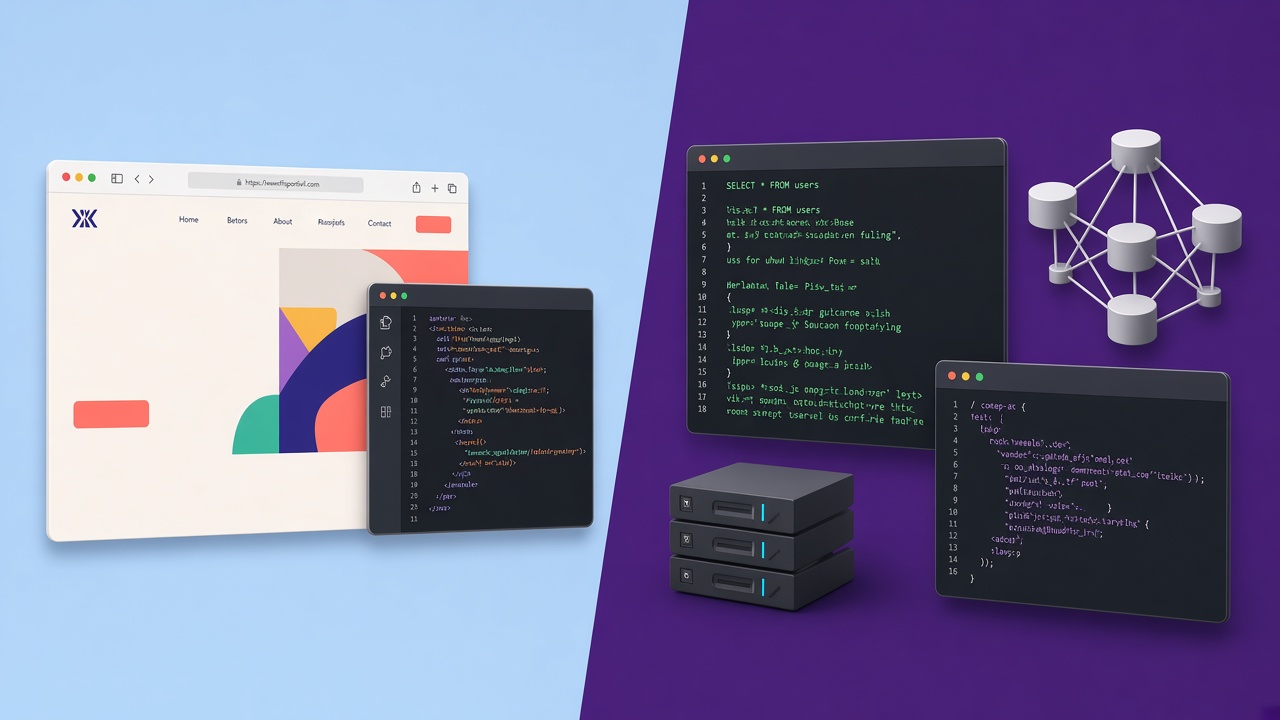
In web development people constantly talk about frontend and backend, but the difference is simpler than it seems: one concerns what the user sees and uses, the other everything that happens “behind” to make the site work. Understanding this distinction is fundamental if you want to study web development, choose a specialisation or talk better with technical teams and suppliers.
What the frontend is
The frontend (client-side) is the visible part of a site or an app: layout, colours, texts, buttons, menus, animations and interactions. In practice it is everything the user comes into contact with in the browser or in the app. A good frontend is not only “beautiful”: it must be readable, accessible, fast and consistent on mobile and desktop.
The main skills in the frontend are:
- HTML for semantic structure (headings, landmarks, accessible forms).
- CSS for layout (Flexbox, Grid), responsive design and design tokens.
- JavaScript for interactivity: menus, client-side form validation, dynamic components.
- Responsive design and tests on real devices, not only emulators.
- Cross-browser compatibility and progressive enhancement.
Frameworks such as React, Vue or Svelte are often used for complex projects (dashboards, large e-commerce). For brochure sites, light HTML/CSS with little JS can be the best choice for performance and maintenance.
A practical example: an “Add to cart” button that changes state, shows a counter and animates the feedback is frontend work. Typography, colour contrast and keyboard focus also fall into this area.
What the backend is
The backend (server-side) is the hidden part: it handles logic, data and security. It is what makes login, databases, payments, admin panels, email sending, APIs and every operation that cannot be entrusted only to the browser without exposing secrets or business rules work.
The main skills in the backend are:
- A server-side language: PHP, Node.js, Python (Django/Flask), Ruby, Go, depending on the context.
- Databases: relational (MySQL, PostgreSQL) or document (MongoDB) with efficient modelling and queries.
- REST or GraphQL APIs to let the frontend and external services (payments, CRM) communicate.
- Security: authentication, authorisations, input validation, CSRF/XSS protection, backups.
- Infrastructure: servers, cache, queues, logs, deploy.
Example: when you submit a contact form, the backend validates the data, applies anti-spam rate limiting, saves it in the CRM and sends a notification email. The visitor only sees the confirmation message.
How frontend and backend communicate
In modern projects, frontend and backend are often separate but coordinated. The browser requests data via HTTP at an API endpoint; the server replies in JSON; the frontend updates the interface without reloading the whole page (SPA) or with traditional server-rendered navigation.
- A classic PHP site: the server generates complete HTML; less JS, simple SEO, excellent for blogs and corporate sites.
- JAMstack / headless: a static front or a framework + API + a headless CMS.
- A full-stack monolith: Laravel, Rails, Next.js with integrated API routes.
For anyone commissioning a site: what matters is that both parts are reliable, not that the fashion of the moment is used.
Full-stack, DevOps and nearby roles
Anyone who covers both worlds is a full-stack developer. It does not mean knowing everything at expert level, but finding your way around the whole flow. Related roles:
- DevOps / platform: CI/CD, containers, monitoring.
- UI/UX designer: research and interface, often in tandem with the frontend.
- QA: manual and automated tests before release.
Which path to choose?
The frontend attracts those who love the immediate visual: you change CSS and see the result. The backend attracts those who prefer logic, data and scalability problems. There is no “superior” choice: excellent sites are born from teams that respect both disciplines.
Common questions
Can I do only frontend or only backend? Yes. Many careers are specialised. In small agencies or as a freelancer, knowing the other side helps you estimate times and costs.
What is easier to start with? Usually the frontend, because the results are visible immediately. If you like data and automation, the backend can feel just as natural.
Essential tools to start? An editor (VS Code), Git to version, the browser DevTools. For the backend add a local database, Postman to test APIs and the official documentation of the chosen language.
Do I have to learn a framework immediately? Better to consolidate base HTML, CSS and JS, then introduce a framework when you understand what it solves (components, state, routing).
A checklist for a site that really works
- Frontend: accessibility, mobile-first, few blocking scripts.
- Backend: server-side validation, backups, security updates.
- Together: error monitoring, HTTPS, separate staging environments.
Conclusion
The frontend takes care of the visual experience and the interaction; the backend of the logic and the data. They are two different but complementary worlds: a well-made site works when both work together, with clear goals (speed, security, conversions) and not only with trendy technologies.