An introductory guide to search engine ranking
A complete guide to the basics of SEO: crawling, indexing, ranking, on-page, link building, schema markup, metrics and mistakes to avoid to improve the organic ranking of your site.
In a world in which online visibility is essential for the success of any business, knowing the basics of SEO (Search Engine Optimization) has become fundamental for developers, marketers and website owners. SEO is the set of strategies and techniques that help a site rank better in the search engine results, increasing visibility and bringing organic traffic, that is visits that arrive without having to pay for ads.
This article explores the key concepts of SEO and the most important practices to understand how search engines work and how to optimise a site effectively, without chasing shortcuts, but building solid foundations that last over time.
What is SEO?
SEO, or Search Engine Optimization, is the process of optimising a website to make it more understandable and more “findable” by search engines such as Google. The main goal is to improve ranking in the organic results, so as to increase visits, the credibility of the brand and the opportunities for conversion.
When we talk about SEO, in reality we talk about a job that moves on more than one level. On one side there is everything that happens directly inside the pages, such as content, the structure of the headings, the use of keywords and the optimisation of images. On the other there are external elements, such as the reputation of the site and the links coming from other authoritative portals. Finally there is the technical part, which concerns speed, security, structure, accessibility and mobile compatibility. These three areas work together: if one is weak, it often also limits the others.
How do search engines work?
To really understand SEO, it is useful to understand in a simple way what a search engine does. Google and the other engines analyse billions of pages and try to show the user the most useful and relevant results. To do this, they follow three main steps that repeat continuously.
The first step is the exploration of the pages, called crawling. The engines use bots, often called crawlers or spiders, that visit the sites and follow the links to discover new pages and update existing ones. During this phase, the crawlers read content, links, titles, images and many other signals.
After exploring the pages, indexing arrives. The information collected is organised in an enormous “index”, like a digital library. When a person does a search, Google does not search the web in real time, but consults this index to find the pages that seem most suited to answering the user’s question.
Finally there is ranking, that is classification. Among all the available pages, the engine chooses the order of the results based on very many factors. It is not only a matter of keywords: the quality of the content counts, the clarity, the reliability of the site, the user experience and many other signals that serve to understand how much that page can really satisfy the search intent.
What is needed for an effective SEO strategy
An effective SEO strategy always starts from the understanding of what people search for. Keyword research serves precisely to identify the terms and phrases that users type on Google when they look for a product, a service or a solution to a problem. It is important, however, not to stop only at search volume: sometimes a highly searched keyword is also extremely competitive, while a more specific search can bring fewer visits but more interested users who are more inclined to contact you or buy.
After the keywords, the most important part is the content. Google tends to reward the pages that offer clear, useful and complete answers. A good piece of content is not simply long or full of keywords: it is a well-structured text, easy to read, with clear titles, orderly paragraphs and truly relevant information. When you write, the goal should always be the same: to help the user find what they are looking for without confusion and without useless sentences.
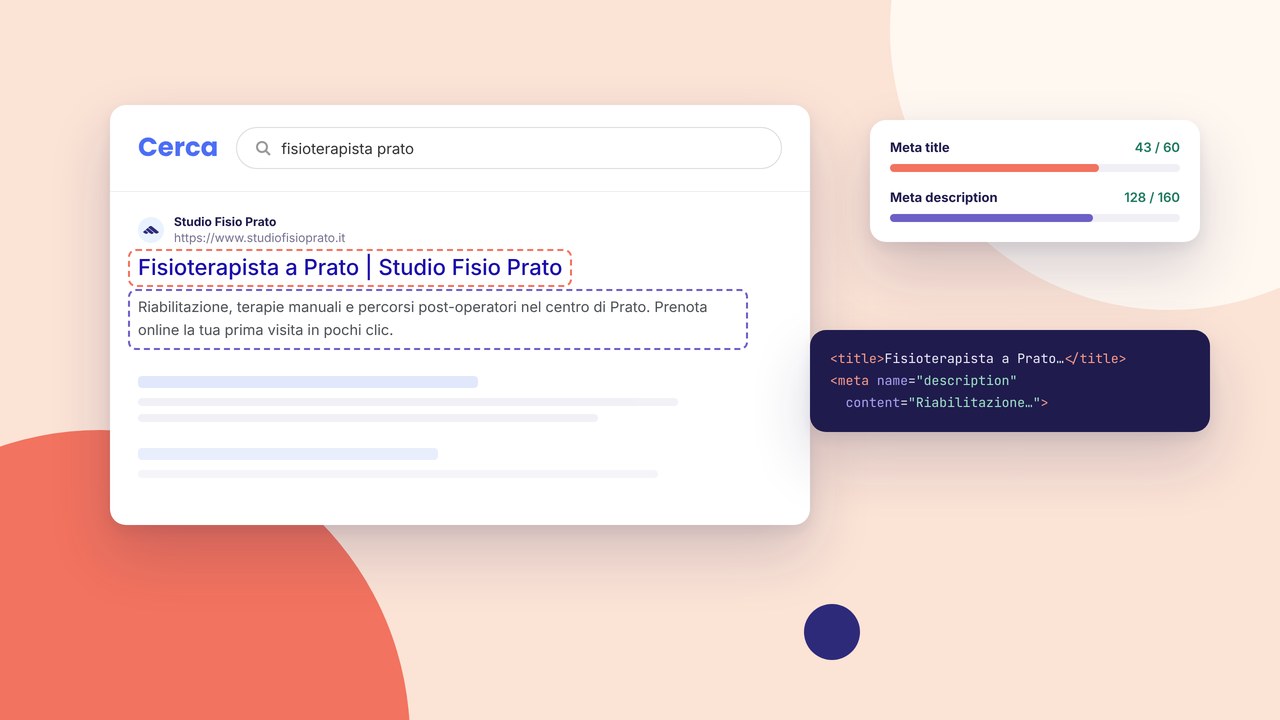
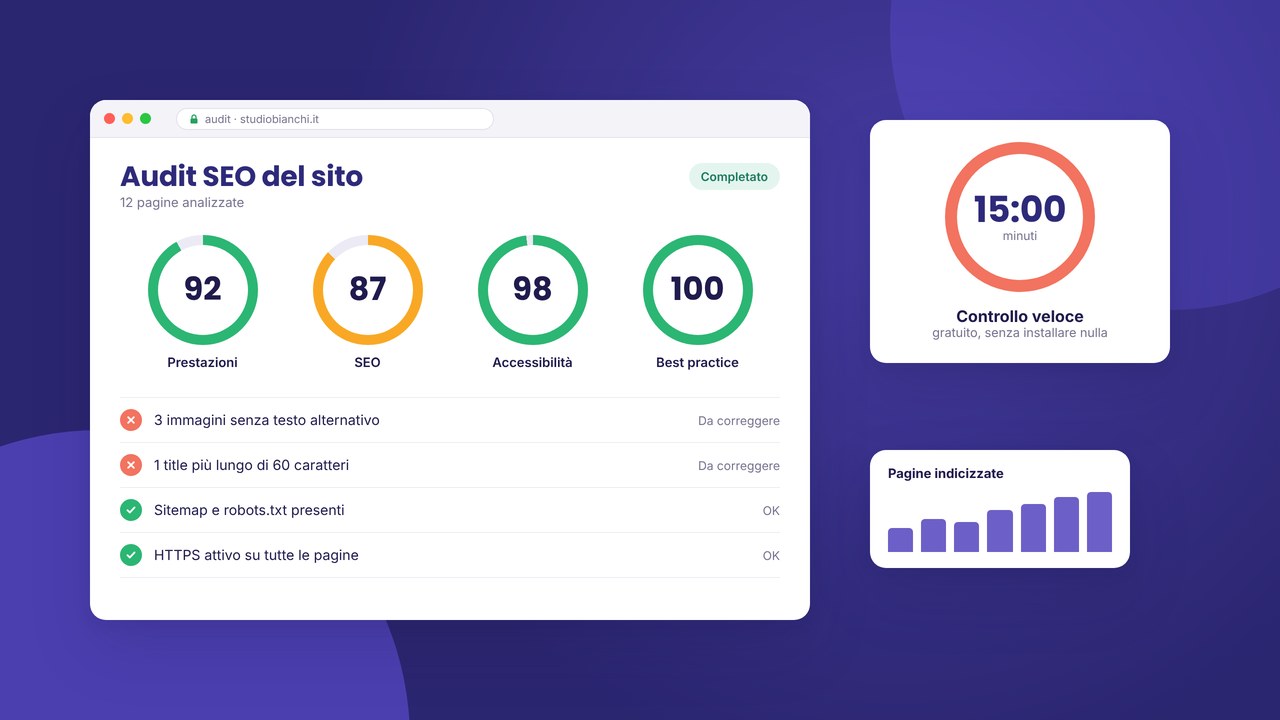
At this point on-page optimisation comes into play, that is everything that makes the page more understandable both to users and to search engines. The page title and the meta description must be consistent with the content and invite the click, without exaggerated promises. The H1, H2 and H3 titles must guide reading and communicate the hierarchy of the information. Images must also be taken care of: not only because they improve the page, but because they help understanding, and with a well-written alt text they contribute to accessibility and indexing. Finally the URLs also count: better short, readable and descriptive, because they are clearer both for Google and for the user.
Technical SEO is the area that is often underestimated, but it can change everything. A slow or unstable site is a problem both for users and for Google, because it worsens the experience and makes it hard to crawl the pages. Security is another requirement: HTTPS is now a standard, and having an SSL certificate is indispensable to protect the data and transmit reliability. Mobile optimisation is also fundamental: today a large part of searches happens from a smartphone and Google evaluates the content giving priority to the mobile version of the site.
Finally there is online reputation, which also goes through link building. Obtaining links from reliable and relevant sites helps to build authority and credibility. It is important, however, to distinguish between quality and quantity: a few good links are better than many low-level links. Incorrect practices such as buying links or spam can lead to penalties and compromise the growth of the site over time.
Common questions about SEO
One of the most frequent questions concerns the times. SEO is a path, not a switch. In general it takes months to see significant results, often between three and six months, but the real times depend on the sector, the competition and how well the site already starts “set up”. The point is that SEO builds value over time: it does not bring immediate peaks like advertising, but it can become a stable source of traffic and contacts.
Another very useful concept is that of long-tail keywords. They are more specific and detailed searches, with less volume but often more effective because they intercept a precise need. Anyone who searches in a specific way is usually closer to taking an action: informing themselves, contacting or buying.
And as for social media? Social does not directly influence ranking as if it were an “official” Google factor, but it can increase the visibility of the content, bring traffic and favour shares and citations that over time can also turn into natural backlinks. In practice they are not pure SEO, but they can help the overall growth of the project.
Schema markup and structured data
Structured data (JSON-LD) help search engines interpret the content with precision: articles, products, FAQs, breadcrumbs, organisation. They do not guarantee better positions on their own, but they increase the probabilities of rich snippets, information panels and inclusion in synthetic answers. Implement only schemas consistent with what the page really shows: Google penalises misleading or incomplete markup.
Start from Organization or LocalBusiness (if applicable), WebSite with SearchAction for site search, Article for the blog posts and FAQPage where you answer frequently asked questions in an explicit way. Always test with the Rich Results Test tool before you publish.
How to measure SEO progress
SEO requires clear metrics to understand whether you are going in the right direction. Besides keyword rankings, monitor:
- Organic traffic and the main entry pages (Google Search Console, Analytics)
- CTR in the SERPs: a good ranking with a low CTR signals titles or snippets to improve
- Conversions from organic: contacts, sales, sign-ups
- Indexing coverage: indexed vs excluded pages, 404 errors and redirects
- Core Web Vitals on mobile and desktop
Set monthly reports and compare trends over at least 90 days: SEO is not evaluated over one week.
Common mistakes to avoid
Many sites start with good intentions but make recurring mistakes that slow growth:
- Keyword stuffing: unnatural texts full of forced repetitions
- Duplicate content: the same pages with different URLs, www/non-www versions not canonicalised
- Neglect mobile: broken layouts on smartphones, unreadable fonts, tap targets that are too small
- Aggressive link building: buying links, private networks, unnatural anchor text
- Neglecting Search Console: indexing errors ignored for months
The golden rule remains the same: optimise for the user, not for an imaginary algorithm.
SEO, SEM and content marketing: how they integrate
SEO, SEM (Search Engine Marketing, that is paid ads) and content marketing are not in competition: they complete each other. SEO builds visibility over time; SEM brings immediate results on strategic keywords; content marketing feeds both with useful materials that generate natural links and trust.
A balanced approach plans quality content as an SEO base, paid campaigns to test messages and keywords, and remarketing for anyone who has already visited the site. In the long term, a good organic ranking reduces dependence on paid advertising.
Conclusion
SEO is a fundamental practice for anyone who wants to increase the visibility and the organic traffic of their website. From keyword research to the quality of the content, from on-page optimisation to the technical part, every element contributes to building a more solid, clearer and more competitive site.
Understanding and applying the basics of SEO does not mean “cheating” Google, but making your site better for whoever visits it and easier to interpret for search engines. And it is precisely this that, over time, brings concrete results.