Innovation and the Future of the Web
How sites, content and digital experience will change
An analysis of how websites, content and digital experience are changing: AI, performance, privacy, omnichannel, metrics and the role of the professional in the web of the future.
The web we know today is no longer only a set of pages to browse, but a living environment that changes together with people, technologies and the contexts in which it is used. Talking about innovation and the future of the web, therefore, does not only mean listing new fashions or tools, but trying to understand in which direction the digital experience is moving, what will really remain important and what instead is destined to disappear in the background noise.
In recent years we have witnessed a profound transformation: sites are no longer static shop windows, but digital products that must work for a precise goal. Bringing contacts, sales, bookings, or simply making it clear in a few seconds who you are and why they should trust you. In this scenario, innovating does not mean running after every new technology, but knowing how to choose what makes sense to adopt to create simpler, faster and more human experiences.
One of the strongest changes concerns the role of artificial intelligence. AI has entered the workflow of anyone who designs and develops websites, but it is also changing the way people find them and use them. Search engines are becoming ever more conversational: they do not only show a list of links, but they start to synthesise answers, to highlight blocks of content, to interpret the context of whoever is searching. This means that the future of the web will be less based on “who is first on Google” and more on “who offers clear, structured and credible content, ready to be read and understood also by an algorithm”.
In this scenario the content returns to the centre, but no longer understood as infinite text full of keywords. What counts is the real quality, the ability to explain, to guide, to answer precise questions. A site that looks to the future is not the one that uses the right words to please a search engine, but the one that puts people’s problems at the centre and faces them with clarity. Innovation, in this case, is not so much technological as mental: passing from the logic of “let’s fill the space” to that of “let’s say exactly what is needed, in the simplest possible way”.
Alongside the content, another pillar is performance. The web moves onto different devices, not always stable networks, contexts in which the user has very little time. It is useless to have spectacular graphics if the page takes ten seconds to open or if a form locks at the moment of sending. The future of the web is made of sites that do less, but do it better. Light interfaces, animations used with judgement, optimised images, clean code. They seem like technical details, but they are what make the difference between a fluid experience and one that frustrates and makes people close the page in a few seconds.
Besides speed, there is the topic of accessibility. The web of the future cannot afford to exclude anyone. It is not only a matter of rules or guidelines, but of respect for anyone who uses assistive technologies, has visual or motor difficulties, or simply browses in non-ideal situations. An accessible site is a clearer site for everyone. Readable contrasts, understandable texts, keyboard navigation, consistent interactive elements. Innovation here is not something futuristic, but a return to the essential: really putting yourself in the shoes of whoever is browsing, with needs and limits different from ours.
Design plays a key role in all this. In recent years we have passed from interfaces full of frills to cleaner layouts, where every element has a reason to exist. The future of the web goes in this direction: fewer free effects, more visual hierarchy, more attention to micro-details. A clear button, a well-written confirmation message, immediate feedback when something goes wrong. These are the things that make a site perceived as “modern”, much more than a graphic trend of the moment.
Another aspect that is changing is the border between website and application. Ever more often a site is not only something to read, but to use. Booking, buying, uploading documents, managing your profile, interacting with a team. Web apps turn the browser into a real workspace, and the future will see this trend grow further. The point, however, is not to replicate native apps in a forced way, but to understand when it makes sense to bring certain features onto the web and how to do it without sacrificing simplicity and stability.
On the business front, the web stops being an “online business card” and becomes an integrated part of company processes. An e-commerce talks with the management software, a contact form feeds the CRM, an internal dashboard shows in real time numbers and data useful for taking decisions. It is no longer only communication, but organisation. Innovation, in this sense, is building sites that talk with other systems, that reduce manual work, that remove friction instead of adding it.
You cannot talk about the future of the web without touching the topic of privacy and data. People are ever more aware of what they share, of the cookies they accept, of how they are tracked. Regulations become more stringent and browsers change the way they handle third-party cookies. The result is that sites must learn to collect data in a cleaner, more transparent and more respectful way. Trying to hide invasive banners or force consents is not a sustainable strategy. The web that will come will reward whoever builds trust with clarity, simple options, explanations understandable even to anyone who is not technical.
Inside all this, artificial intelligence will have a growing role, but not as a total replacement of human work. Rather as a tool to speed up processes, generate drafts, analyse data, propose variants. It is easy to be dazzled by the idea of “having the site made by AI”, but the truth is that an effective digital project requires choices, priorities, compromises, knowledge of the context. Things that today artificial intelligence cannot handle on its own. The most interesting future is not the one in which AI replaces the professional, but the one in which it supports them, taking away the weight of repetitions and leaving more space for the strategic and creative part.
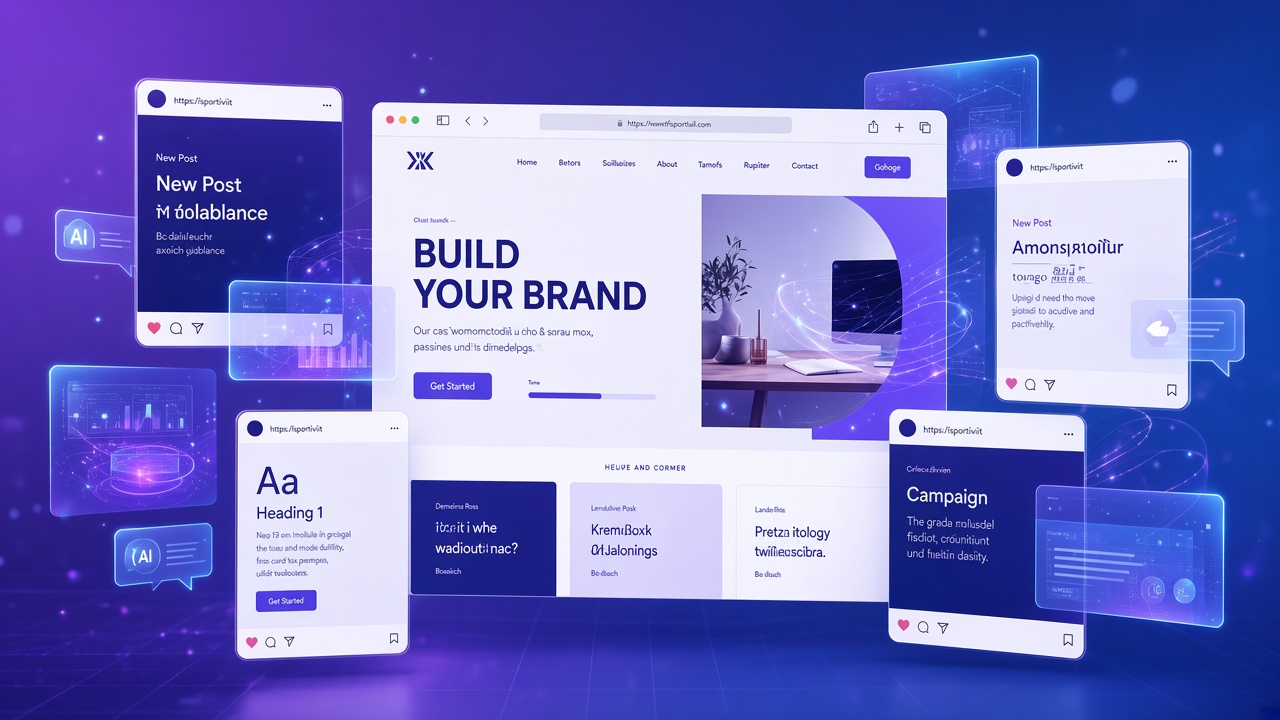
The relationship between brand and user will also change further. If once it was enough to have a “nice” site and update the content every now and then, now the user expects continuity. It is not only a matter of publishing articles on the blog, but of keeping the experience consistent between site, newsletter, social, any apps. Innovating, in this case, means creating paths that make sense, connecting the dots, avoiding jumps of tone or of quality. A user who arrives on the site after having met you on Instagram must find the same identity, the same level of care, the same clarity.
Finally, there is a topic often underestimated: sustainability. Every web page has an energy cost. Extremely heavy images, videos loaded without judgement, useless scripts that run in the background are wastes that translate into worse load times, servers more under stress and more consumption of resources. The future of the web will inevitably go towards greater attention to these aspects. Optimising is not only a matter of performance, but also of responsibility. Creating light, clean and well-designed sites means respecting the time of whoever is browsing and, at the same time, the environment in which we live.
In short, the future of the web is not made of a single great revolution, but of many small daily choices. Choosing to design for people before algorithms. Choosing clarity instead of technicality. Choosing quality instead of the race to “quick and now”. Technologies will change again, new tools will arrive, new languages, new formats. But the thread that will hold everything together will always be the same: creating digital experiences that make sense, that really work and that improve people’s lives, even only in a small way.
If there is a real innovation to chase, it is precisely this: stopping seeing the web as something to fill and starting to treat it as a space to design with care, where every choice has an impact on the way we present ourselves, communicate and build lasting relationships over time.
Personalisation and privacy: finding the balance
Users expect made-to-measure experiences, but they are ever more reluctant to share data. The web of the future will have to personalise with first-party data (behaviour on the site, explicit preferences, an account) and total transparency on what is used and why. Third-party cookies in decline, server-side tagging and granular consents become the norm.
Design useful paths even without aggressive profiling: clear content for segments, recommendations based on the context of the session, explicit opt-ins for the newsletter and notifications. Trust is a competitive asset.
Omnichannel: consistency between touchpoints
Site, app, social, email, a physical shop (if present) must tell the same story. The same tone, visual, information on hours and services. A user who passes from Instagram to the site to the contact form must not feel they are changing company. A design system, brand guidelines and a shared editorial calendar help keep alignment.
Metrics that count in 2025
Besides pageviews and bounce rate, orient yourself towards:
- Task completion rate: does the user complete the planned action?
- Core Web Vitals and the perception of speed
- Conversion rate by channel and device
- Customer effort score: how tiring is it to obtain support or information?
- Retention and returning visitors: do they come back because they find value?
Better data, not more data: measure what guides concrete decisions on content, UX and investments.
The role of the professional between automation and humanity
AI, no-code and templates accelerate production, but they do not replace judgement, empathy and a product vision. The value of the designer, the developer and the content strategist remains in translating human needs into digital solutions that work. Better tools free time for the part that counts: listening, prioritising, taking care of the details that make the difference.